Classes are free but require students to purchase the ARRL License manual, the basis of course material. "Ham Academy" drill software provided on Internet has proved to help students master the material.
This event was for alumni on the east coast! It was a
special pau hana with University of Hawai‘i President, David Lassner,
featuring alumni-owned Tiki’s Grill & Bar!
All three of Tiki's are partners are UH Mānoa alumni, Both Kelly McGill, Partner, and Michael Miller, Director of Operations and Partner spoke about how the University of Hawai‘i shaped them and the company.
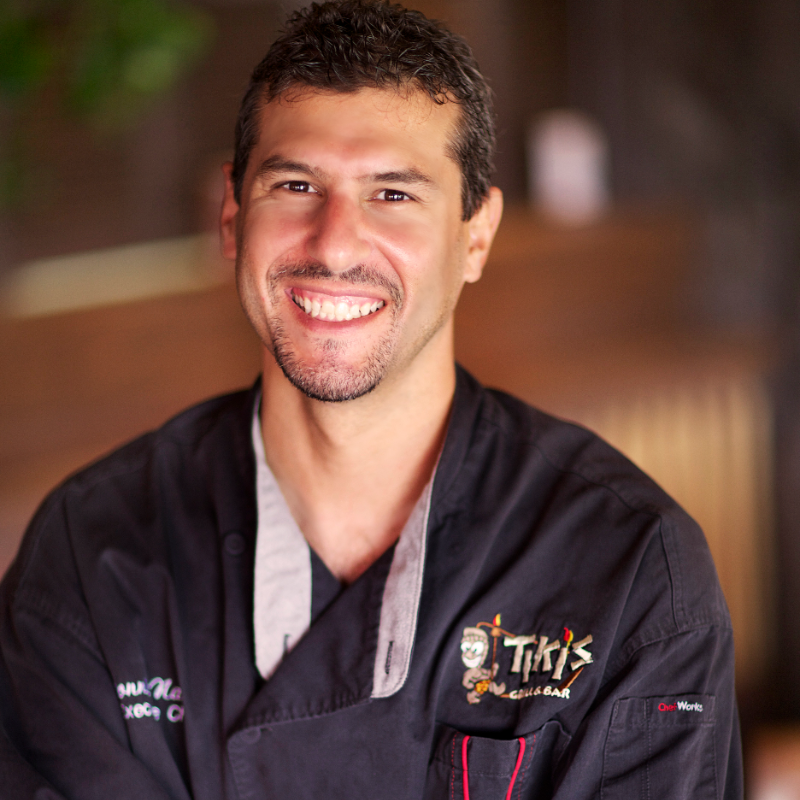
We then watched renowned Chef Ronnie’s demonstration on how to create Prime Rib Poke and then Bartender Marcos Laramix taught how to may your own signature Strawberry Squeeze during this virtual event.
The $25 ticket included a special package that shipped ahead of the April 22 event. Making sure guests got their commemorative Tiki’s glass and drink umbrella ready for mixing
your Strawberry Squeeze!
Recipe cards for the dish and drink demo were included along with other fun items. Enjoy a taste of aloha spirit, guests showed off their UH pride and recreate featured recipes from our pau hana. To be invited to the next event please contact the UH Office of Alumni Relations at contact@uhalumni.org.

Kelly McGill, partner of Tiki’s Grill & Bar at the Aston Waikiki Beach Hotel, graduated from the School of Travel Industry Management at UH Mānoa with his Bachelor of Science degree.
Originally from San Jose, California, Kelly chose to stay in Hawai‘i post-grad to surround himself with what he refers to as “the greatest people on earth”. While at UH, he was an offensive lineman on the 1991 and 1994 football teams. He started at right tackle on the 1992 co-WAC championship and Holiday Bowl championship team and received honorable mention All-WAC performer in his senior year as well.
Kelly credits his experiences studying and playing at the university with shaping his current attitude toward quality of life. In addition to the greatest people on earth, Kelly stayed in Hawai‘i to grow his family in a safe, loving environment that enjoys food, the outdoors and sharing of culture. Since graduating from UH, Kelly’s had travel opportunities to Asia, Africa, Europe and mainland USA with work. Additionally, his work experiences have afforded him opportunities to live in South Africa, Australia and Vietnam, where he met his wife. Kelly and his wife, Thao McGill, have two children – each very involved in multiple sports like their dad.

Michael Miller has more than 30 years of management, training, sales, operations, marketing, and public relations experience in Hawai‘i hospitality and business.
Michael is a graduate of the UH Mānoa with his degree in communications. He was a member of the UH sailing team and as an ASUH vice president helped launch the UH Mānoa Shuttle Bus, lobbied for what is now the Stan Sheriff Center, and funding for other notable buildings on campus.
He is a past Chairman the Hawaii Restaurant Association (HRA) and is still active on the legislative committee is a board member for the Hawaii Food Bank and KCC’s Hospitality and Tourism advisory board. He’s also been a member MEG - National Restaurant Association's Marketing Executives Group for over 10 years.
Michael holds the call sign of KH6ML as an Amateur Radio extra class operator and is a volunteer Community Emergency Coordinator and a technical specialist, who can be activated to help in disaster by the President, the Red Cross, the Department of Emergency Management and others.
For 17+ years he has been with Tiki’s Grill & Bar, many of those years as the Director of Operations and now as a partner, overseeing the 10,000 sq. ft. restaurant and bar, with many of the best employees in Waikiki. He and his partners also run the popular Christmas Bar Hawaii pop-up restaurant every year.
Born and raised in Hawai‘i, Michael graduated from Maui High and grew up fishing, diving, and hiking. He is proud to have six generations of his family from Hawai‘i.

Following a proven record of successful and distinguished accomplishments, Chef Ronnie has chosen to hang his hat at Tiki’s Grill & Bar, steering this favorite destination for locals and visitors alike to a higher level of dining and excellence.
Chef Ronnie, who believes in the farm-to-table movement by visiting farms and building strong bonds with local farmers, brings in island fresh produce and breads, as well as local grass-fed beef and locally caught or raised fish every week. His delicious signature items and dinner specials that fuse Hawaiian/Pacific Island with American cuisine are the result of his dedication to the craft and cooking with locally grown and raised food. An effective and motivational trainer from both the front and back of the house, Chef Ronnie continues to be inspired by working with the best chefs in the world.
His advice to aspiring chefs: “Be sure you love it wholeheartedly. If you don’t, you won’t make it. If you do, it will be a more than gratifying experience and career choice.”
Amateur radio, often referred to as ham radio, is practiced across the globe by hobbyists and enthusiasts. And they are often every bit the expert as professional military communicators and signalmen. The term “amateur” refers not to their technical acumen but to the private, nonbusiness use of allocated radio bands by those possessing amateur radio licenses. Further, while voice communication mode is the most common use of ham radio, such operators can also send and receive text, images and data. Based on technical specifications and applied technique, ham radio operators can send and receive communications across the world, across multiple bands. --Maj. Brian Kerg, USMC, is a Marine Corps officer and writer currently serving as the fleet amphibious communications officer, U.S. Fleet Forces Command..2021
The joint force is regularly called upon to conduct operations below the threshold of decisive combat, often in response to escalating tensions or natural disasters. In such contingencies, regularly available communications networks are commonly unavailable. The Internet, cellphones and other networks dependent upon terrestrial facilities become overloaded or knocked out of service. Consequently, crisis action planners are handicapped in their efforts to coordinate with key officials on the ground, as well as limited in the amount of local intelligence they can collect to support timely and appropriate action.
While such complex and brittle networks succumb to fracture, organic means of communication remain available and abundant—if only planners know where to look and how to tap into it. Amateur radio, often referred to as ham radio, is practiced across the globe by hobbyists and enthusiasts. And they are often every bit the expert as professional military communicators and signalmen. The term “amateur” refers not to their technical acumen but to the private, nonbusiness use of allocated radio bands by those possessing amateur radio licenses. Further, while voice communication mode is the most common use of ham radio, such operators can also send and receive text, images and data. Based on technical specifications and applied technique, ham radio operators can send and receive communications across the world, across multiple bands.
The Defense Department does have a mechanism by which to employ amateur radio operators and connect joint planners with key nodes in the area of operation. The Military Auxiliary Radio System (MARS) is a Defense Department-sponsored civilian auxiliary of amateur radio operators that actively supports military operations. Notably, military aircrews remain capable of using MARS phone patches through high frequency radios when satellite communications are unavailable.
However, use of MARS remains a largely unknown or niche capability, one that is usually stumbled upon by planners in the moment of crisis and then poorly implemented. Awareness of MARS was further hampered with the closing of Navy and Marine Corps MARS components in 2015. Only the Army and Air Force retain formal ties to MARS. Consequently, while the department has the means by which to establish communications networks in denied and degraded command and control environments, this resource remains underutilized. Instead of harvesting an organic communications resource in such crises, joint planners struggle through limited communications and intelligence challenges as they fight for access to high-demand, low-density resources such as satellite phones.
The joint force can rectify this cheaply and simply by providing awareness of ham radio networks to joint planners and facilitating greater access to amateur radio training for military radio operators. Communications and signal planner courses across the services can integrate instruction regarding MARS, and how to employ it, in as little as a 15-minute block from the training schedule. Field radio operator courses can similarly provide an initial exposure to amateur radio, paired with the key lesson that local nationals in any environment to which they might deploy will likely be employing ham radio. Commands can sponsor local chapters of amateur radio enthusiasts, use white space in the field to practice amateur radio techniques and provide a path for operators to pursue an amateur radio license. The wide variety of annual amateur radio competitions can further incentivize military operators to improve their amateur radio skills while inevitably improving proficiency in their mission-essential tasks.
As future threats continue to evolve, day-to-day communications architectures will become more unreliable in times of crisis. It is imperative that joint communications planners turn to ‘amateurs’ to remain experts. By building awareness of how to employ MARS and training military radio operators in ham radio technique, leaders will ensure their planners are proactively leveraging the organic amateur communications networks that abound across the globe.
Maj. Brian Kerg, USMC, is a Marine Corps officer and writer currently serving as the fleet amphibious communications officer, U.S. Fleet Forces Command. He is a nonresident fellow at Marine Corps University’s Brute Krulak Center for Innovation and Creativity. Follow or contact him @BrianKerg.
Winlink hut coming together
Site preparations well under way
Toyota loaded to the gills with gravel, about 1.5t. Decided to put 100kg of concrete powder on bonnet to help hold front wheels down for traversing steep road
Mick VK4NHX fitting new hoses to machine
Mick up and running building a new piece of road to negate the existing steep sections on the access road
The crew digging the foundation holes. From left, Les VK4FLES on shovel, Chris VK4FGKO also on shovel, Bob VK4FRC on the water tank hose, Ray VK4XXX on the Dingo digger, arguing with the tough digging work. Ground is harder than concrete!
When the digging gets tough, add more weight :-) from left, Mick VK4NHX, Trevor Bell, Chris VK4FGKO and Ray VK4XXX
Mixing starts, from left is Les VK4FLES (our resident concreter) and Chris VK4FGKO on shovel!
From left, Jack VK4JRC and trusty Dingo pouring in the mix, Chris VK4FGKO observing, Les VK4FLES guiding the mix into the hole and Mick VK4NHX (our resident foreman) supervising!
Les VK4FLES finishing off troweling around the foundations.
VK4LM Jack Picasso handy work :)
At left, Mick VK4NHX, Les VK4FLES and Trevor cutting out insulation on tray of Landcruiser.
Chris VK4FGKO and Ray VK4XXX installing insulation.
It’s up and bolted down :-) Now to start the fitout.
From left Chris VK4FGKO, Mick VK4NHX, Jack VK4JRC and Les VK4FLES.
Winlink site from the air.
View of winlink shed and what appears to be an abandoned vehicle :)
Ray VK4XXX chief solar engineer at work!
From left, Les VK4FLES, Mick VK4NHX (Project Works Foreman) Ray VK4XXX laying out panels on mounting hardware.

Solar panel brace installed by VK4LM and VK4NJR
From left Mick VK4NHX, Merv VK4DV, Ray VK4XXX, Les VK4FLES (Concrete engineer) Neil VK4NJR. Taking advantage of cooler weather to get some more site works completed. Installation of the antenna feed point pole, for the sky loop antenna. Coax to shed has been laid underground in conduit. The RT-600 antenna tuner will be mounted on the pole and supplied with 12volts via a bias-t from the solar system.
Chris VK4FGKO holding ladder for Ray VK4XXX as he slides the remote ATU enclosure up the pole.
The enclosure final mount point at top of pole.
Concreting Wireless Internet and VHF beam mounting pole and conduit into trench.
Neil VK4NJR slaving over a hot shovel!
Ray VK4XXX on shovel
Jack VK4LM and Chris VK4FGKO working out 4G panel antenna mount.
Les VK4FLES checking 4G panel antenna mounting.
Jack VK4LM feeding cable into conduit.
Kay VK4FKJW supervising work, Ray VK4XXX sorting cable into conduit
Chris VK4FGKO and Les VK4FLES taking a break.
Today’s finished job! Battery installed, solar charger installed wired and working great. 19in cabinet in place awaiting equipment install. Loop antenna up and ready for some RF
You can see the 4G patch antenna installed on the pole to the left, at this stage the yagi top left of shed is in use. We are modifying, updating and testing a number of things to make this gateway the best it can be.
A view from a bit higher up. You can just pick out the VHF (vara fm) yagi atop the pole
Ver 1
Ver 2
VK4LM Winlink node is online and installed in it's final site.
System is scanning dial frequencies 3590 7057 10130 14100 modes Ardop Pactor and VARA HF with a IC7200 connected to a Chameleon CHA SKYLOOP antenna. FT8800 on 144.075FM mode VARA FM on a home brew 3E horizontally polarized yagi. The PC stick has been getting a work out with concurrent connections on Pactor HF and VARA FM VHF with out a problem.
We have been getting connections from ZL1 ZL2 ZL4 VA VK1 VK2 VK3 VK4 VK5 VK8 JA K7 SA6 as well as our local test team VK4JRC and VK4FLR on most bands and modes with good reports. Jack has been giving 160M a work out mobile also with great results (160M currently offline). Been able to maintain connections mobile on Mt Morgan range as well as Mt Morgan CBD. Capricorn Highway Burnett Highway and Gracemere CBD also work fine. Rockhampton CBD noise floor is a bit much. I have also used the gateway from the mobile on 30M in the CBD during the Emergency Services Day 2019. Watch this space for more mobile and field deployment testing.
Please Note: VK4LM is running VARA HF 4.3.2 and VARA FM 4.0.5
We have dropped support for Winmor. Over the last month (10 - 11/2020) winmor has been locking up VK4LM and has required a restart to release the TNC. Because of this we have been forced to remove it as a supported soundcard mode. Sorry of any inconvenience.
The below from www.winlink.org website.
10
July 2020 -- The Board of Directors of the Amateur Radio Safety
Foundation voted in a recent virtual meeting to deprecate the WINMOR HF
mode in the Winlink system. We request all HF RMS gateway sysops still
offering WINMOR to remove it in favor of ARDOP, VARA HF and Pactor 3 or
4, where permitted by local rules.
The system will fill a big hole in the coverage of VKs East coast and the Pacific Ocean. It is a hybrid gateway so if the internet is down emails will be forwarded via HF radio to a node with internet it will then forward emails to the CMS.
1st episode of 2021
Hawaii welcomes you back to the islands. Hawaii Posts provideds you with updates on safe travel programs and we sit down with Michael Miller Director of operations and partner of Tiki’s Grill and Bar to discuss the current state of tourism and business is re-opening up in Waikiki in Hawaii abroad. Also we have a Surf Report weather forecast current events and Tom e Stokes nuggets of knowledge.
Enjoy the show!
Tom-e-stokes
https://hawaiiposts.libsyn.com/e-komo-mai-welcome-to-hawaii