|
I was able to speak with 6
counties
on the radio. I was using a Icom ic-7300 and a G5RV jr antenna with 100 watts: Call sign KH6ML, I was only able to be on the air for a limited amount of time. So getting 4 new ones in the log was great. "Many leading contesters claim the WAEDC to be the most challenging contest of the year. Being a true blue DX contest, only intercontinental QSOs between DX and Europe are counted (exception is the RTTY part). Therefore the number of DX QSOs here may be similar to the amount of DX usually worked in the CQWW." -https://www.darc.de/der-club/referate/referat-conteste/worked-all-europe-dx-contest/en/ I was able to speak with 6
counties
on the radio. I was using a Icom ic-7300 and a G5RV jr antenna with 100 watts: Call sign KH6ML
Moreover, the unique feature of QTC-traffic adds much fun and another operating challenge to the contest. Here the DX stations transfer real telegrams to the European stations. These telegrams contain data of previously logged QSOs. Each of these records counts one additional point for the sender and the receiver, given that the complete record was logged correctly. Thus, a DX station can actually double its score by sending QTCs. Some European stations, and not only the leading ranks, gain more than 70 percent of their score from QTC traffic. - https://www.darc.de/der-club/referate/referat-conteste/worked-all-europe-dx-contest/en/ WAE DX Contest, SSB: 0000Z, Sep 12 to 2359Z, Sep 13 | |||||||||||||||||||||||||||||||||||||||||||||||||||||||||||||||||||||||||||||||||||
| Geographic Focus: | Europe | ||||||||||||||||||||||||||||||||||||||||||||||||||||||||||||||||||||||||||||||||||
| Participation: | Worldwide | ||||||||||||||||||||||||||||||||||||||||||||||||||||||||||||||||||||||||||||||||||
| Mode: | SSB | ||||||||||||||||||||||||||||||||||||||||||||||||||||||||||||||||||||||||||||||||||
| Bands: | 80, 40, 20, 15, 10m | ||||||||||||||||||||||||||||||||||||||||||||||||||||||||||||||||||||||||||||||||||
| Classes: | Single Op (High/Low) Multi-Op |
||||||||||||||||||||||||||||||||||||||||||||||||||||||||||||||||||||||||||||||||||
| Max operating hours: | Single Op: 36 hours, off times of at least 60 minutes Multi-Single: 48 hours |
||||||||||||||||||||||||||||||||||||||||||||||||||||||||||||||||||||||||||||||||||
| Max power: | HP: >100 Watts LP: 100 Watts |
||||||||||||||||||||||||||||||||||||||||||||||||||||||||||||||||||||||||||||||||||
| Exchange: | RS + Serial No. | ||||||||||||||||||||||||||||||||||||||||||||||||||||||||||||||||||||||||||||||||||
| Work stations: | Once per band | ||||||||||||||||||||||||||||||||||||||||||||||||||||||||||||||||||||||||||||||||||
| Score Calculation: | (see rules) | ||||||||||||||||||||||||||||||||||||||||||||||||||||||||||||||||||||||||||||||||||
| Submit logs by: | September 20, 2020 | ||||||||||||||||||||||||||||||||||||||||||||||||||||||||||||||||||||||||||||||||||
| E-mail logs to: | (none) | ||||||||||||||||||||||||||||||||||||||||||||||||||||||||||||||||||||||||||||||||||
| Upload log at: | https://www.dxhf.darc.de/~waessblog/upload.cgi?form=referat&lang=en | ||||||||||||||||||||||||||||||||||||||||||||||||||||||||||||||||||||||||||||||||||
| Mail logs to: | (none) | ||||||||||||||||||||||||||||||||||||||||||||||||||||||||||||||||||||||||||||||||||
| Find rules at: | http://www.darc.de/der-club/referate/referat-conteste/worked-all-europe-dx-contest/en/ | ||||||||||||||||||||||||||||||||||||||||||||||||||||||||||||||||||||||||||||||||||


Today I made a voice contact with OH0B on
The Åland Islands.
The Åland Islands or Åland is an
archipelago province at the entrance to the Gulf of Bothnia in the
Baltic Sea belonging to Finland. It is autonomous, demilitarised and is
the only monolingually Swedish-speaking region in Finland since 1920 by a
decision of the League of Nations.Wikipedia
| 2020-09-06 | 07:34 | OHØB | 20m | 14.254 | SSB |  |
Aland Islands | Martti J. Laine OH2BH | Contest |

In
compliance with government mandates, Tiki’s will be closed for dine-in
starting Thursday, August 27th.
We know we will get through this together. Malama Pono!
We look forward to opening soon!!!

SECOND STAY AT HOME / WORK FROM HOME ORDER
Dallis Ontiveros | KHON2 interviews me Michael Miller in three live segments on the morning TV show. Most of the Questions relate the the Mayor's Emergency Order 2020-24 Act Now Honolulu - No Social Gatherings August 19, 2020 from OFFICE OF THE MAYOR CITY AND COUNTY OF HONOLULU EMERGENCY ORDER NO. 2020-24 (COVID-19 [Novel Coronavirusi).
Restaurants. This section applies to restaurants only. For purposes of this section, a ‘Restaurant” means a place which is regularly and in a bona fide manner used and kept
Open for the serving of meals to patrons for compensation and which has suitable kitchen facilities connected therewith, containing the necessary equipment and supplies for cooking an assortment of foods which may be required for ordinary meals. Additionally, to be considered a “Restaurant” under this section, at least thirty percent (30%) of the establishmenfs gross revenue must derive from the sale of foods. Restaurants in the City may provide seated table service dining under the following requirements, conditions, and privileges:
Continued compliance with all State of H awai’i and City regulatory and legal standards for operating a food services business.
Compliance with Social Distancing Requirements (as modified by this “Restaurants” section).
Development, posting, and implementation of written protocols (“COVID-19 Mitigation Plan”) consistent with this section; Centers for Disease Control and Prevention (“CDC”) guidance (available here: https://www.cdc.gov/coronavirus/201 9-ncov/communitv/guidance- business-response.html), as updated or superseded; and, to the extent practicable, the National Restaurant Association’s Reopening Guidance (available at https://restaurant.org/Downloads/PDFs/business/COV ID I 9- Reopen-Guidance.pdf).
Today I checking into the
The Maritime Mobile Service Network (MMS).

The Maritime Mobile Service Net is operational every day from 12:00pm until 9:00pm Eastern Standard Time, and from 12:00pm until 10:00pm Eastern Daylight Time, on the 20-meter *Global Emergency Center Of Activity frequency of 14.300 MHz as outlined by the International Radio Union.
All amateur radio operators are invited to participate simply by checking in.
Radio Society of Great Britain

Propagation News – 26 July 2020
We had quite a quiet week with the Sun with zero sunspots and a settled geomagnetic field. The solar wind speed was slow, between 280 and 330km per second, and its magnetic field was weak, with no significant negative deflections in its important north-south Bz direction. Therefore, the resultant geomagnetic activity was settled.
On the 21st a sunspot appeared around the Sun’s limb. Now classified as sunspot group 2767, on Thursday it contained one sunspot, but its simple uni-polar magnetic signature suggests it is non-threatening.
We do expect the Kp index to rise on Friday, the 24th, due to the arrival of a coronal hole high speed stream. Modest magnetic enhancement is also forecast for 25 July with the possible arrival of a slow CME from the 19th.
Expect a possible pre-aurora enhancement followed by the potential for suppressed maximum usable frequencies over the weekend and into early next week.
HF conditions have been generally lacklustre, but Laurie, G3UML reports that WH6FXL and WA6QDQ/KH6, both in Hawaii, were both quite readable signals on 20m SSB at 0800 on Wednesday. Tom, GM4FDM reports working two JAs on 17m using his newly-erected dipole. The 10m UK Net group on Facebook also reported an FT8 opening to Japan on Monday as well.
This just goes to show that you shouldn’t just write off the summer as being no good for DX.
Next week NOAA predicts the solar flux index will remain in the high 60s with the Kp index between two and three. This generally suggests that HF conditions will remain similar to last week. Expect sporadic E openings on 10 metres to continue, although not at the rate that we had earlier in the month.
VHF and up
A series of low-pressure systems passing close by northern Scotland and various fronts crossing the country mean that there are likely to be few opportunities for tropo this week. High pressure is displaced to the south over France so any tropo will be mostly likely from southern England into the continent or across Biscay to Spain. That brings rain scatter on the GHz bands onto the agenda for many regions of the UK at some time or other during the coming week.
Sporadic E still warrants a mention, but it is becoming more elusive as we move towards August. It’s not a ‘no chance’, but it will need some strategy for being in the right place at the right time. The best options will be to monitor 10m or 6m mid-morning and again late afternoon or early evening. Paths on FT8 will prove good indicators of which direction might deliver as the Es develops.
With the Moon declination negative and falling further as the week progresses, Moon visibility windows will shorten and peak elevation will be just 32 degrees this Sunday and falling, leading up to minimum declination a week from Sunday.
Perigee will be Saturday, 1 August, so path losses are now increasing. 144MHz sky noise peaks at 2,500 Kelvin on Friday, so low noise preamps won’t help you that day.
The Southern Delta Aquarids meteor shower has a broad peak from the 26th to the 31st with a Zenithal Hourly Rate of 25, so look for enhanced meteor scatter activity in the coming week. In Europe, the shower radiant is above the horizon at night or in the early mornings.
Category: GB2RS Propagation News
WH6FXL - Results EARCHI.org END FED 6–40 Meter Multiband HF Antenna FT-8, Winlink, SSB
25 foot pole with 66'8" of #14 wire sloping in the air
Counterpoise 66'8 of #14 wire on the ground
25' of Coax to a AT-100ProII LDG auto tuner and into a ICOM 7300 running around 100watt. No Amp.
25 foot pole with 66'8" of #14 wire sloping in the air
Counterpoise 66'8 of #14 wire on the ground
25' of Coax to a AT-100ProII LDG auto tuner and into a ICOM 7300 running around 100watt. No Amp.
""Trifilar wound, 9:1 UNUN (unbalance to unbalance) toroid matching transformer that will match the high input impedance of an end fed antenna into the range where most antenna tuners can produce good performance. The matchbox handles 100 watts of power. This project requires an antenna tuner to achieve satisfactory SWR. If you need an auto tuner, we recommend the LDG line of auto tuners, shown to work well with these matchbox antennas, and highly rated by users. http://www.earchi.org/92011endfedfiles/Endfed6_40.pdf
ORDERING A MATCHBOX ANTENNA FROM EARC.- http://www.earchi.org/proj_homebrew.html
| 1 |
2020-07-29 | 06:42 | DL8UI | 17m | 18.102 | FT8 | JO41 |  |
Germany | ||||
| 2 | 2020-07-29 | 06:40 | JR1AQI | 17m | 18.102 | FT8 | PM95 |  |
Japan | ||||
| 3 | 2020-07-29 | 06:38 | F4FCE | 17m | 18.102 | FT8 | JN17 |  |
France | ||||
| 4 | 2020-07-29 | 06:36 | JH0EHQ | 17m | 18.102 | FT8 | PM96 | |
Japan | ||||
| 5 | 2020-07-29 | 06:35 | F4HIK | 17m | 18.102 | FT8 | JN06 | |
France | ||||
| 6 | 2020-07-29 | 06:34 | JH3IOY | 17m | 18.102 | FT8 | PM74qr | |
Japan | ||||
| 7 | 2020-07-29 | 06:32 | VA7ILO | 17m | 18.102 | FT8 | CN89 |  |
Canada | ||||
| 8 | 2020-07-29 | 06:29 | F6EQZ | 17m | 18.102 | FT8 | JN19xf | |
France | ||||
| 9 | 2020-07-29 | 06:22 | OE3XMC | 20m | 14.075 | FT8 | JN88dc |  |
Austria | ||||
| 10 | 2020-07-29 | 06:21 | PC1Y | 20m | 14.075 | FT8 | JO21gx |  |
Netherlands | ||||
| 11 | 2020-07-29 | 06:19 | OE3KLU | 20m | 14.075 | FT8 | JN88fd | |
Austria | ||||
| 12 | 2020-07-29 | 06:13 | JA4JKO | 20m | 14.075 | FT8 | |
Japan | |||||
| 13 | 2020-07-29 | 06:13 | VE7UM | 20m | 14.075 | FT8 | CN89 | |
Canada | ||||
| 14 | 2020-07-29 | 06:10 | EA3GCT | 20m | 14.075 | FT8 | JN01 |  |
Spain | ||||
| 15 | 2020-07-29 | 06:09 | MI0NWA | 20m | 14.075 | FT8 | IO64 |  |
Northern Ireland | ||||
| 16 | 2020-07-29 | 06:05 | ON7WM | 20m | 14.076 | FT8 | JO21 |  |
Belgium | ||||
| 17 | 2020-07-29 | 06:03 | I3BUI | 20m | 14.076 | FT8 | JN55 |  |
Italy | ||||
| 18 | 2020-07-29 | 06:01 | PB75A | 20m | 14.076 | FT8 | JO22ga | |
Netherlands | ||||
| 19 | 2020-07-29 | 05:31 | AI6ZC | 40m | 7.186 | SSB | CM98JP |  |
United States |
| 20 | 2020-07-28 | 06:24 | 7L4LKK | 20m | 14.160 | SSB | QM06gi | |
Japan |
Winlink Stations reached using
EARCHI.org END FED 6–4
Winlink Vara Connection to KH6NS USB Dial: 3585.000 at 2020/07/29 07:06:36 *** Station Bearing: 298, Range: 116 miles
Winlink Vara Connection to WH6FG USB Dial: 7105.500 at 2020/07/29 07:09:56*** Station Bearing: 289, Range: 118 miles
Winlink Vara Connection to K6SDR USB Dial: 7102.200 at 2020/07/29 07:17:39*** Station Bearing: 053, Range: 2384 miles
Winlink Vara Connection to KJ6IX USB Dial: 7100.000 at 2020/07/29 07:23:47 *** Station Bearing: 053, Range: 2548 miles
Winlink Vara Connection to N7TRY-2 USB Dial: 7101.000 at 2020/07/29 07:30:16 *** Station Bearing: 042, Range: 2570 miles
Winlink Vara Connection to K6MBY USB Dial: 7101.500 at 2020/07/29 07:43:13*** Station Bearing: 038, Range: 2657 miles
Winlink Vara Connection to K7HTZ USB Dial: 7101.200 at 2020/07/29 07:47:44*** Station Bearing: 039, Range: 2635 miles
Winlink Vara Connection to KO0OOO USB Dial: 7096.500 at 2020/07/29 08:00:05*** Station Bearing: 059, Range: 2745 miles
Winlink Vara Connection to N0DAJ USB Dial: 7106.500 at 2020/07/29 08:03:25*** Station Bearing: 062, Range: 2860 miles


Hurricane Douglas July 23 2020 Shelter HAM Radio operational notes KH6ML
We were already aware Hurricane Douglas from early news reports and started to review a few things sound the house and my radio grearClem Jung - KH7HO who volunteers as the a Pacific Section Emergency Coordinator with the ARRL Amateur Radio Emergency Service® (ARES). Reached out asking if I would be available to deploy as a volunteer radio shelter operator if shelter need to be opened. I said yes.
Hurricane Douglas was a strong tropical cyclone that became the closest passing Pacific hurricane to the island of Oahu on record, surpassing the previous record held by Hurricane Dot in 1959. After leveling off as a strong tropical storm due to dry air, Douglas began rapid intensification on July 23, becoming the season's first major hurricane the following day and peaking as a Category 4 hurricane.
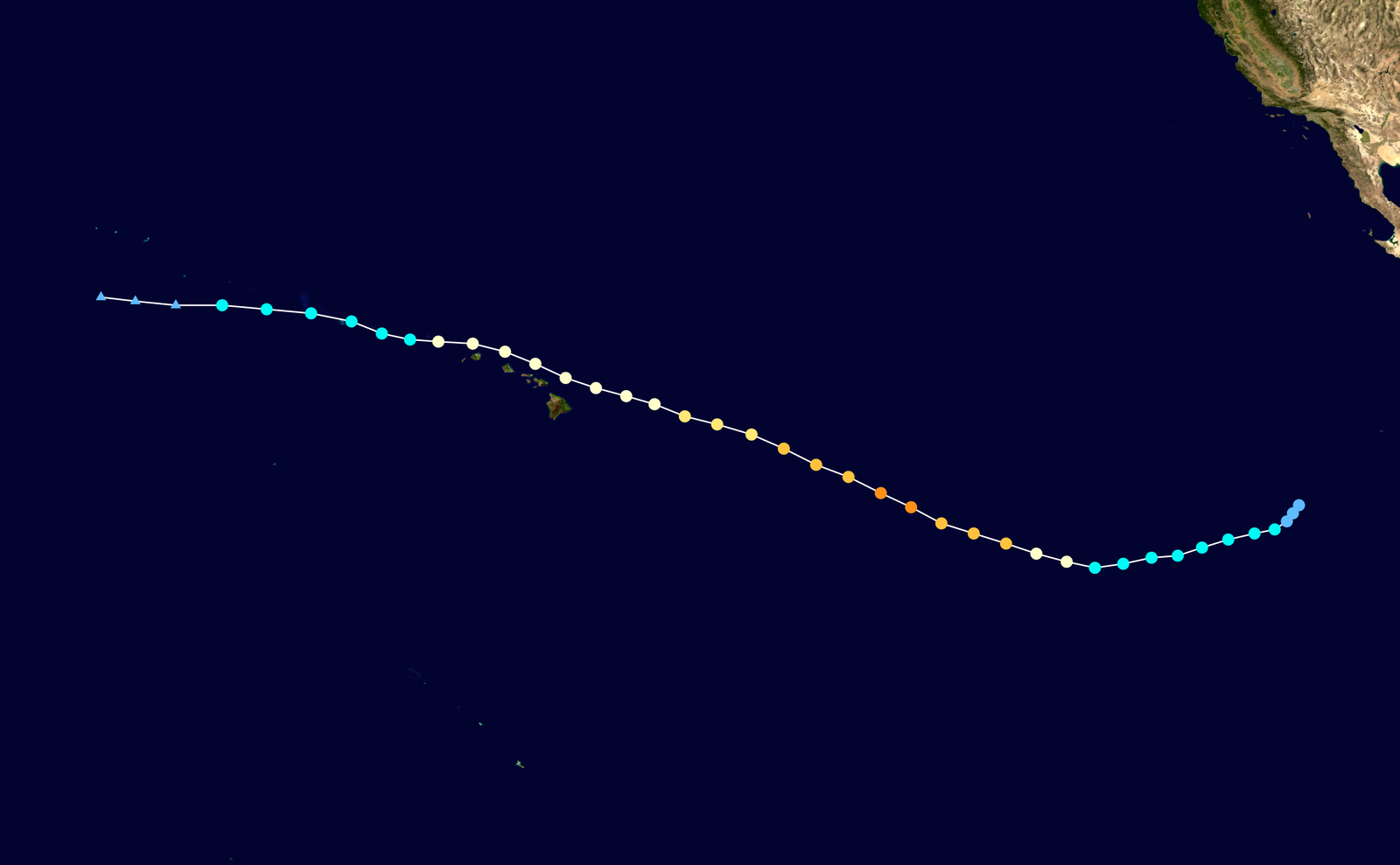
Map plotting the track and the intensity of the storm, according to the Saffir–Simpson scale.
A big mahalo to all of those who spent time, money and effort to design, build and maintain repeaters, software, and servers, and also trained users. It was good to know that so many of you were on monitoring and while many of you also had other responsibilities to your families and jobs.I volunteered with Kevin, WH6OHM, to serve at the Red Cross Shelter at Kalaheo High School (“Kalaheo HS”) on Oahu. We reported two hours before the shelter opened, at 7 am, and stayed for 15 hours until we’re told to demobilize.
We introduced ourselves to the Red Cross shelter manager and gave him a letter of introduction prepared by Clem, KH7HO. He asked us to get screened by the National Guard in attendance. They took our temperature and asked us a series of questions related to COVID-19.We then asked for help from Mr. B who was in charge of facilities for Kalaheo HS. The first location was a storeroom in the cafeteria. Kevin, WH6OHM, pointed out that it only had one outlet and would be loud, if and when the shelter filled up. We were also concerned with coax cable and antennas being possible trip and fall hazards.
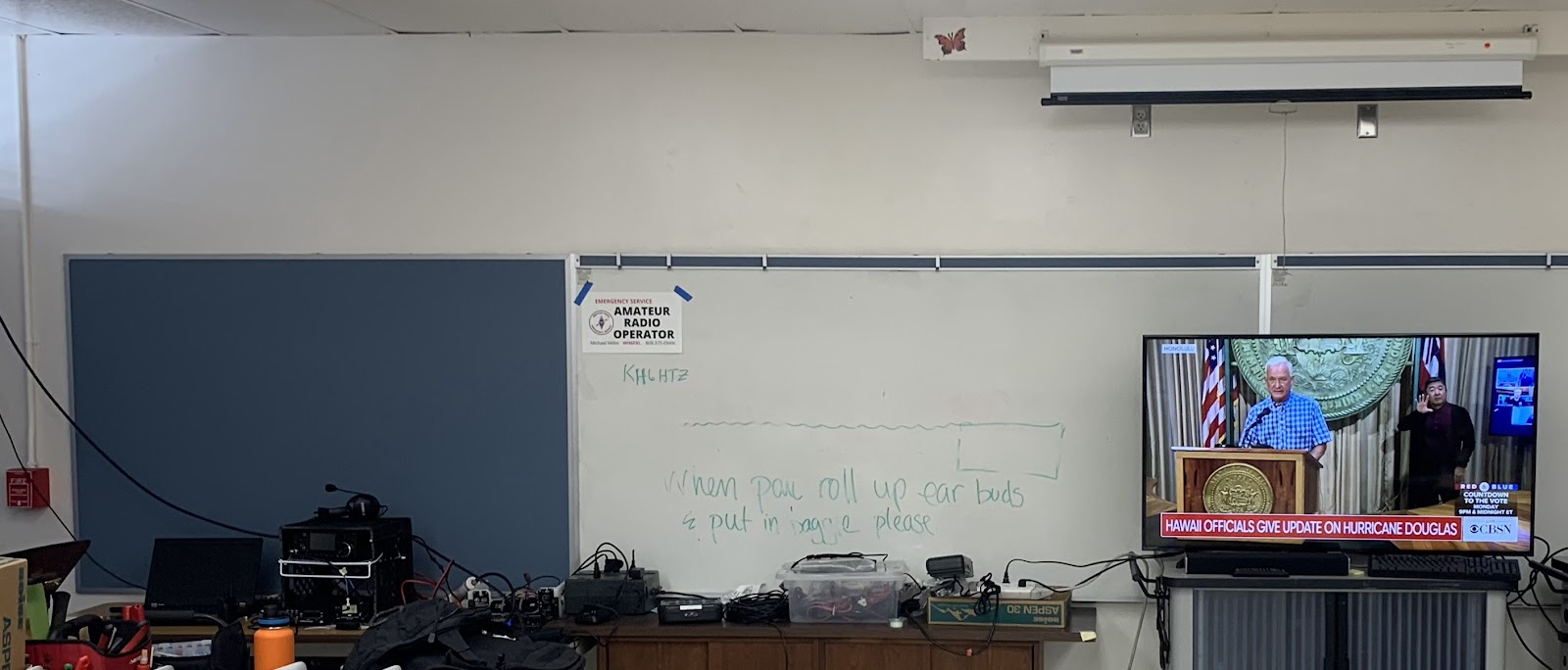
Mr. B then pointed to another building, but its distance was a concern. We discussed the options, walked the grounds, and then he opened up a computer lab. Bingo! What a great spot!This location was at the same level as the shelter and just 25 yards away with concrete walls, close to large trees to hang the antennas. There were also power outlets to run all items on until we needed to go to battery power or the generator. Whiteboards were available for notes and to tape up notes. Desks, tables, carts, and rolling office chairs were aplenty, much better than student plastic chairs or metal folding. The computer lab space also helped with COVID-19 concerns, to ensure safe distance needed for both operators.
There was a large flat-panel TV with limited cable stations, but we could watch the news and could have utilized an HDMI CABLE to connect our laptops for streaming and Winlink message reading by the shelter manager or other officials as needed, without compromising our 6-foot distance protocols. Also, in the room were printers and other components such as a good size UPS that we charged, but subsequently found that it created a large amount of RFI when plugged in. The Cat 5 and other wires and cables may also have proven handy if needed. And the room had AC that was large enough for each of us to set up a rest/sleep area with lots of space.Mr. B helped us find the perfect room for set up and knew who to call to grant us Wifi access and checked back with us often and was back 15 hours later to lockup. And his principal stopped in and who also made things easy and reviewed limiting access to only those tested for COVID with no symptoms. We were very aware that we were trusted guests and treated the room accordingly.
The WH6OHM station was set up as VHF/UHF with a 50W dual band mobile coupled with a DRA-30 sound card to a Windows 10 laptop as a Winlink station and for voice transmissions. We pushed an empty metal file cabinet near the station, and with a mobile magnetic mount on it, near the window. We then tested it to ensure he could reach repeaters and send test Winlink messages to Vara FM gateways NH6NN and WH6FXL.We both had Anytone 868 handheld radios with us and we monitored DMR Hawaii-1 off of the Waimanalo repeater and different analog repeaters.
On my side of the room, we had a backup VHF radio with a mag mount antenna set up outside on a large metal locker. I set up an HF Winlink station with Icom Ic-7300 and an LDG auto tuner. An Anderson power pole distribution box hooked into a power supply and could fast change over to batteries. The Windows 10 laptop with Winlink was set up with a paid version of Vara HF for faster speeds using a single USB cable.Once that was set, we ran coax cable out of a louvered window and knew we needed to keep it well above anyone’s reach. The first spot we looked at would have needed more coax cable. (Note to self get more coax cable for the kit.) I gave Kevin a clean sock and paracord, he added a rock for weight and it only took 3 throws to get it high enough in the tree and into a good position. I attached the G5RV JR and he pulled it up and tied it off.
If the winds increased we would have dropped it until it was safe to put back up. The G5RV JR Wire Antenna hung about 25 feet in the air in a monkeypod tree, as an inverted V and legs tied to the palm trees with a bungee cord which allowed the legs to remain taut, but still have play for the wind and gave us HF multi-band coverage. Forty meters 7.088 LSB was the frequency that was issued in advance that would be monitored by amateur radio operators statewide. Sixty and 80 would have been a challenge, but with time we could have gotten up on those bands.A great way to test propagation and equipment without tying up designated frequencies for the emergency is using FT-8 and pskreporter.com. It allowed us to see that we could reach out to the US mainland and other countries if needed.
I tested HF voice with a call and was picked up by Carter KH6FV. His voice was recognizable, but his call sign had been changed to the station that he was running. Then we sent a test message via the Kauai Winlink gateway.When the Emergency Management sirens sounded statewide, DMR Hawaii Net was on talk group Hawaii-1. They had operators report in their area and note if they’d heard the siren. As WH6OHM and I were in the same room, there was no need for both of us to give a report.
Kevin, WH6OHM, used a Winlink template, filled in a American Red Cross ARC-213 and sent it to the assigned address, as well as me. (This allowed both of us to see what was sent as well as validate that it got out.)Check-ins at designated times with the shelter manager allowed us to fill out an ARC shelter report that had some modifications as the shelters were only set up for hurricane evacuation, not for displacement of people from their homes, so no food and very limited services were being offered to the evacuees. The main information that was needed was age groups and counts of both evacuees as well as volunteers and what agencies they were from.
We limited the use of radio to Winlink and sometimes used Telnet to keep frequencies clear in case other stations needed to transmit. Using Winlink in an emergency situation is a powerful tool, but much like handing someone an advanced weapon to shoot down a plane. Without the proper training you may be able to get something fired off, but will it hit its designated target?So practicing well in advance and at the start of deployment is critical to having success when passing messages via amateur radio. This goes for both digital modes such as Winlink, as well as voice messages.
Volunteering from 7 am to 10 pm - 15 hours did make it a long day. However, it was rewarding getting to know my fellow operator, as well as providing community service and testing our own equipment when deployed. We were tasked with passing messages via amateur radio, voice, and data modes, and sending emails via Winlink.More about Douglas, After moving into the Central Pacific basin, Douglas slowly weakened as it approached Hawaii. The storm later passed north of the main islands as a Category 1 hurricane, passing dangerously close to Oahu and Kauai, causing minimal damage, and resulting in no deaths or injuries. Douglas weakened to tropical storm status on July 28 as it moved away from Hawaii, before dissipating a day later.
MAHALO to God for keeping us safe.Mahalo to my fellow amateur radio operators that deployed to shelters and other critical organizations.
Mahalo to those who brought all their own equipment to serve the community, and to those operators that supported us from home.Mahalo to all the volunteers, the Red Cross, the Medical Reserve Corps, National Guard, and government employees that were kind to the evacuees and volunteers who were extremely professional and served their community.
Mahalo to my wife who helped me load up, made sandwiches, packed my lunch, and more; and kept working on getting ready just in case. The plan was she and our dog, Kula, would come to the shelter if the situation worsened, home was a 7 minute drive away.We also build masts, ready to deploy with additional antennas. We brought backup batteries and radios, a generator with 36 hours of fuel (plus fuel in vehicles that could have been siphoned if the need was critical enough) in addition to power cables, wire and computers, connectors, a soldering gun and other tools.
We are now back to “normal." Luckily Douglas was nice to us and just passed Oahu by. Maybe he heard about the mandatory 14-day quarantine?



IARU HF World Championship
Objective: To support amateur self-training in radiocommunications including improving amateur operating skills, conducting technical investigations, and intercommunicating with other amateurs around the world, especially IARU member society headquarters stations, using the 160, 80, 40, 20, 15 and 10-meter bands. 24 HOUR CONTEST. To see more information and results go to http://www.arrl.org/iaru-hf-world-championship

The International Amateur Radio Union iaru.org is an international confederation of
national amateur radio organisations that allows a forum for common
matters of concern and collectively represents matters to the
International Telecommunication Union. The International Amateur Radio
Union was founded in 1925 and, as of November 2019, it is composed of
172 national member societies
Radio amateurs
should always look for opportunities to address communication challenges
through the application of technology. Growing numbers of stations
including Multi Operator stations are capable of being operated
remotely. The IARU encourages their participation in the HF World Championship wherever national regulations permit.
Here is a look at my logbook from QRZ.com
| 1 | 2020-07-12 | 08:55 | DA0HQ | 40M | 7.158 | SSB | JO50lq | |
Germany | Contest Station | |
||
| 2 | 2020-07-12 | 08:52 | JA3AOP | 40M | 7.158 | SSB | PM74kj | |
Japan | AKIRA SUGIYAMA | |
||
| 3 | 2020-07-12 | 08:43 | NH6GY | 40M | 7.158 | SSB | BL11ch | |
Hawaii | ANTHONY M CAMPBELL | |
||
| 4 | 2020-07-12 | 08:40 | KC1XX | 40M | 7.158 | SSB | FN42dr | |
United States | MATTHIAS STRELOW | |
||
| 5 | 2020-07-12 | 08:40 | NX6T | 40M | 7.182 | SSB | DM13ih | |
United States | SAN DIEGO CONTEST CLUB | |
||
| 6 | 2020-07-12 | 08:28 | KH2JU | 40M | 7.181 | SSB | QK23km |  |
Guam | Danilo I Pobre | |
||
| 7 | 2020-07-12 | 07:23 | KT7E | 20M | 14.322 | SSB | CN85mm | |
United States | JOSEPH B BATTY | |
||
| 8 | 2020-07-12 | 07:18 | UW5Y | 20M | 14.322 | SSB | KN28wh |  |
Ukraine | Contest Call | |
||
| 9 | 2020-07-12 | 07:13 | MM0HCD | 20M | 14.322 | SSB | IO86ea |  |
Scotland | Fraser Williamson | |
||
| 10 | 2020-07-12 | 06:28 | S53MM | 20M | 14.315 | SSB | JN76gd |  |
Slovenia | Matija Brodnik | |
||
| 11 | 2020-07-12 | 06:27 | OZ1HQ | 20M | 14.305 | SSB | JJ00aa |  |
Denmark | EDR Headquarters | |
||
| 12 | 2020-07-12 | 06:26 | EA3CI | 20M | 14.295 | SSB | JN11nu | |
Spain | LLUIS . | |
||
| 13 | 2020-07-12 | 06:24 | KK6P | 20M | 14.276 | SSB | CM95pn | |
United States | Rolling Ranch Contest Club | |
||
| 14 | 2020-07-12 | 06:21 | SN0HQ | 20M | 14.254 | SSB | KO02mf |  |
Poland | Special call for IARU HF World Championship | |
||
| 15 | 2020-07-12 | 06:19 | TM0HQ | 20M | 14.247 | SSB | JJ00aa | |
France | HQ HQ Station | |
||
| 16 | 2020-07-12 | 06:17 | F5LIW | 20M | 14.221 | SSB | JN27oe | |
France | Alain 'Alan' MINARD | |
||
| 17 | 2020-07-12 | 06:15 | S50HQ | 20M | 14.218 | SSB | JN76bg | |
Slovenia | ZRS ZVEZA RADIOAMATERJEV SLOVENIJE | |
||
| 18 | 2020-07-12 | 06:13 | 9A0HQ | 20M | 14.203 | SSB | JJ00aa |  |
Croatia | Hrvatski radioamaterski savez HRS | |
||
| 19 | 2020-07-12 | 06:10 | ER7HQ | 20M | 14.200 | SSB | JJ00aa |  |
Moldova | ARM HEADQUARTERS STATION ER7HQ | |
||
| 20 | 2020-07-12 | 06:00 | OH2HQ | 20M | 14.263 | SSB | JJ00aa |  |
Finland | HQ Station | |
||
| 21 | 2020-07-12 | 05:42 | DA0HG | 20M | 14.285 | SSB | |
Germany | |
|
|||
| 22 | 2020-07-12 | 05:37 | K6ACV | 20M | 14.178 | SSB | CM95kx | |
United States | David M Miller | |
||
| 23 | 2020-07-12 | 05:36 | W6GAE | 20M | 14.178 | SSB | CM98DE | |
United States | Michael Gaertner | |
||
| 24 | 2020-07-12 | 05:34 | W7VO | 20M | 14.178 | SSB | CN85nt | |
United States | MICHAEL T RITZ | |
||
| 25 | 2020-07-12 | 05:34 | F1RAF | 20M | 14.178 | SSB | JN18kd | |
France | NICOLAS FORTINEAU | |
||
| 26 | 2020-07-12 | 05:30 | HG8A | 20M | 14.296 | SSB |  |
Hungary | |
|
|||
| 27 | 2020-07-12 | 05:24 | OL0HQ | 20M | 14.331 | SSB | JJ00aa |  |
Czech Republic | Czech Radio Club HQ Station | |
||
| 28 | 2020-07-12 | 02:41 | KE8FT | 20M | 14.218 | SSB | EN82ij | |
United States | Giuseppe Molinaro | |
||
| 29 | 2020-07-12 | 02:35 | VE5MX | 20M | 14.218 | SSB | DN89aq | |
Canada | Einar Todd Bendtsen |